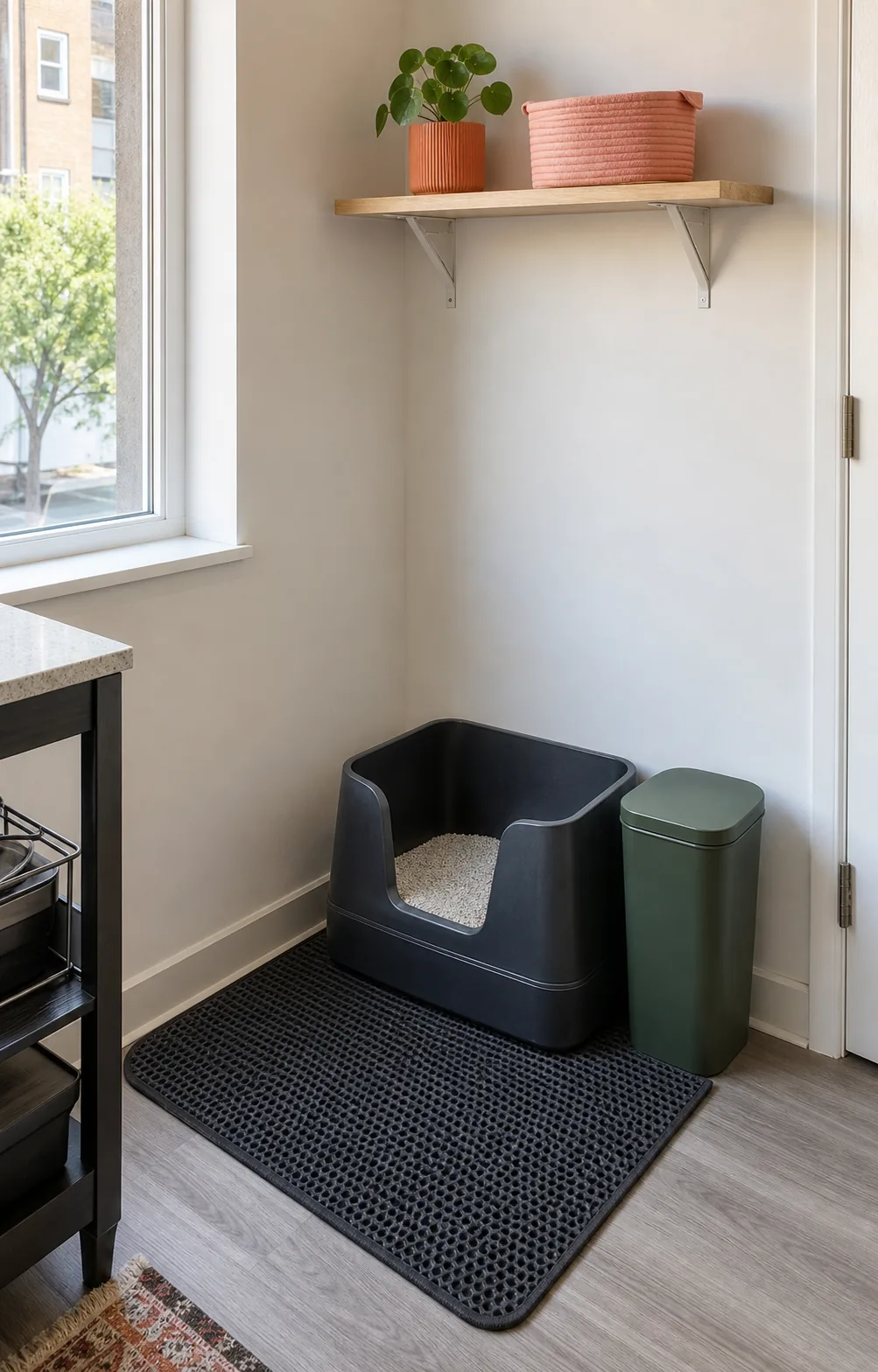
Published July 23, 2026
This workflow maps the movement of clean supplies toward the box and removed waste away from it. It helps a small home avoid storing heavy bags in unreachable corners or placing a waste container inside the only cleaning position. It does not make sanitation, odor or pest-control claims. Follow product instructions, local disposal rules and professional advice where health or contamination concerns exist.
Evidence boundary: This guide provides planning and measurement logic. It is not veterinary advice, a behavioral diagnosis, or a hands-on product test.
1. Inventory volume, weight and replenishment rhythm
List each supply kept for the litter setup: unopened litter, opened litter, liners or bags, scoop, brush, disposable materials and cleaning tools. Record package dimensions and listed weight for the exact product. Then record how often it is purchased and how much is normally stored. A bulk bag may lower unit cost while creating a lifting or floor-space problem that a small home cannot support.
Separate reserve storage from daily-access storage. The full package can remain in a stable low location while a smaller accurately labeled container serves routine refills, provided the product instructions permit transfer and the household can keep it secure. Do not decant materials into an unlabeled container or imply that one storage method is safe for every product.
- Measure unopened and opened package dimensions.
- Record listed package weight and the intended lift route.
- Separate reserve quantity from daily working quantity.
- Assign every scoop, bag and brush a reachable location.
- Keep product labels and instructions available.
2. Draw the clean-supply route
Trace the path from the entry door or delivery point to reserve storage, then from storage to the litter box. Measure the narrowest doorway and turning point for the largest package. Identify stairs, high shelves, low cabinets and places where the bag must be set down. The goal is to avoid a purchase size that fits the cabinet but cannot be carried or poured through the planned route.
At the litter zone, reserve a stable refill position that does not block the cat route or require holding a heavy container over an awkward obstacle. Rehearse with an empty box matching the package dimensions, not with loose litter. Count the number of transfers and write down where spills could be reached for cleaning. This is a geometry and workload check, not a prediction of dust or product performance.
3. Draw a separate waste route
Map the sequence from scoop to temporary container to the building's accepted disposal point. Record the container footprint, lid operating clearance and the position required to remove a full bag. The container should not occupy the cleaning stance, narrow the box entrance or block a room door. If it sits inside furniture, include the furniture door and bag-removal route in the operating envelope.
Check local building and municipal disposal requirements rather than assuming one method. Do not promise odor containment from a format illustration or a general category. Exact bag compatibility, seal mechanism and maintenance instructions are product-specific and must be verified against the current named model.
| Stage | Object and measure | Route question |
|---|---|---|
| Delivery | Largest unopened package | Can it clear doors, stairs and turns? |
| Reserve storage | Package footprint and lift height | Can it be stored without unstable stacking? |
| Daily refill | Working container and pour position | Can it reach the box without blocking access? |
| Scoop station | Tool reach and temporary placement | Can the complete action occur inside the service zone? |
| Waste container | Footprint, lid sweep and bag removal | Does it preserve cat and owner routes? |
| Final disposal | Full bag route | Does the route comply with building and local rules? |
4. Calculate storage cost per usable month
Use the monthly cost planner to estimate consumption from actual purchase frequency. Divide the usable quantity stored by the monthly quantity used to estimate how many months the reserve represents. Then compare package sizes on both cost and workflow. Include containers bought only to handle a larger package and the floor or shelf area reserved for them. Do not assign a monetary value to space unless the household has a real alternative cost.
A lower unit price is not automatically a better small-space decision. If the package creates an unsafe lift, cannot stay dry under its instructions or blocks required access, remove it from the shortlist. Keep price observations dated because Amazon prices and availability change; the site should not display a current price without a compliant update mechanism.
5. Create a reset standard
Define the condition that ends each cleaning cycle: scoop returned, bag closed, floor edges reachable, refill container secured and both routes clear. A reset standard makes the layout repeatable for multiple household members. It should describe object positions and clearances, not make cleanliness or health guarantees.
Review the plan when package size, litter type, waste system, disposal rule or household lifting ability changes. Preserve exact product identifiers for any container or accessory linked from the site. If a named product changes dimensions or default variant, pause its offer until identity and specifications are verified again. Date each workflow review and retain the prior measurements so a package or disposal change can be traced instead of reconstructed from memory.