Published July 23, 2026
This planner turns each possible location into the same six-part comparison. Instead of choosing the least visible corner, record the usable rectangle, the route into it, the route a person needs for cleaning, nearby moving objects, surface conditions and what must happen when the box is removed. The result is not a universal best room. It is a transparent shortlist built from the limits of one home and one cat.
Evidence boundary: This guide provides planning and measurement logic. It is not veterinary advice, a behavioral diagnosis, or a hands-on product test.
1. Draw candidate zones, not single points
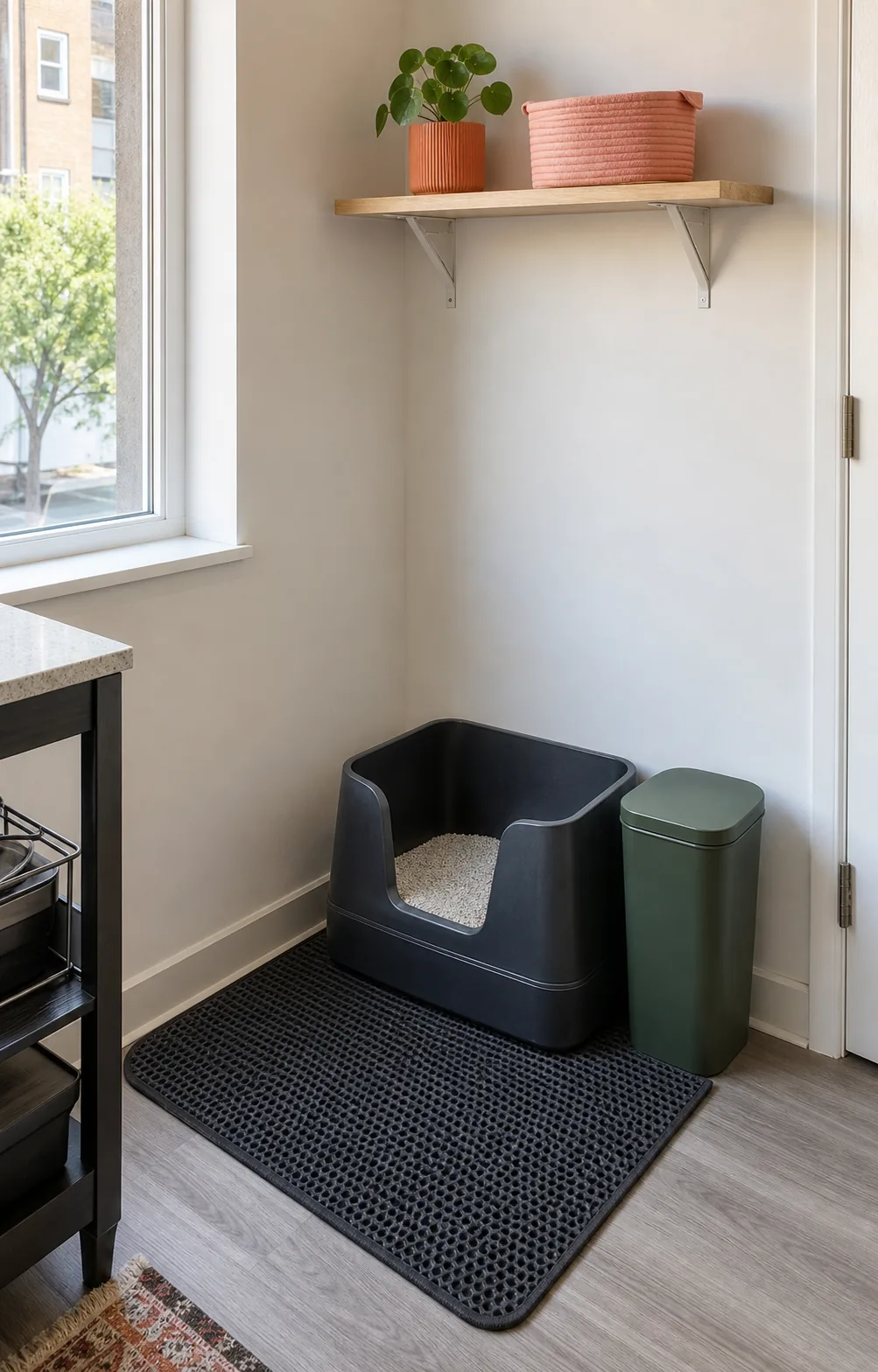
Mark every location that could remain available for the next several months: a bathroom edge, laundry alcove, hallway recess, bedroom corner or open closet bay. Draw a rectangle for the full service zone rather than a dot for the box. The rectangle should include the box footprint, the exit mat, any sealed waste container and the floor where a person will stand or kneel to scoop. A location is not usable when these parts overlap a door, heater, appliance service panel or the only clear walking lane.
Measure width and depth at floor level because trim, pipes and baseboards can make the lower area smaller than the wall above it. Record the narrowest repeatable dimensions, not the widest diagonal or a measurement taken before the door is opened. If an item has to be moved every day to use the box, treat that movement as part of the layout rather than pretending the area is continuously clear.
- Label each candidate A, B, C or D on a simple floor sketch.
- Record the smallest clear width and depth in inches.
- Mark the box entrance direction and the first two steps after exit.
- Draw the owner cleaning position and the path used to remove waste.
- Cross out any zone that blocks required access to utilities or exits.
2. Protect two different access routes
The cat route and the cleaning route are different. A cat may enter through a narrow side opening while a person needs enough front or top clearance to lift a scoop, remove a liner or carry the entire box. Measure both routes separately. For the cat route, note the clear opening width, turning area and whether another pet or a closing door can remove the only approach. For the cleaning route, rehearse the largest action: pulling the box forward, lifting the hood or carrying the tray without tilting it through a tight corner.
A strong candidate keeps both routes available during ordinary room use. Do not score a room while the door is held in an unusual position or laundry is temporarily removed. Use the layout that exists on a normal weekday. Where a location has only one approach, record that as a resilience risk rather than assuming it will always remain open.
3. Score moving, wet and noisy constraints
Door swings, cabinet fronts, shower curtains, rolling hampers and appliance doors create moving boundaries. Open each one fully and measure the remaining rectangle. A near miss is not comfortable clearance: the mat can creep, the box can rotate during cleaning and a person can place it back slightly differently. Reserve a visible buffer instead of relying on two objects never shifting. In a bathroom or laundry area, also note where water reaches the floor and whether the surface can be cleaned without trapping moisture under a mat or cabinet.
Noise should be recorded as an observation about the location, not as a claim about what every cat will tolerate. List predictable events such as a washer spin cycle, a frequently slammed door or a ventilation fan. If the cat already avoids that location during those events, that is household-specific evidence worth weighting. If behavior changes suddenly or elimination occurs outside the box, the planning worksheet is not a diagnosis; contact a veterinarian to rule out health concerns.
| Constraint | Record | Pass condition |
|---|---|---|
| Service rectangle | Smallest clear width × depth | Box, mat and cleaning position fit without moving required furniture |
| Cat route | Opening, turn and alternate approach | Normal doors and objects do not remove access |
| Cleaning route | Pull-out or lift direction | Box can be serviced without tipping or obstruction |
| Moving objects | Door and drawer sweep | A repeatable buffer remains when everything is open |
| Surface | Water, seams and cleanability | Floor can be inspected, cleaned and dried |
| Routine events | Noise and traffic schedule | The location remains usable during ordinary daily activity |
4. Use a weighted decision instead of hiding tradeoffs
Give every candidate zero, one or two points for service fit, cat access, cleaning access, moving-object clearance, surface management and routine stability. Zero means the requirement fails during normal use, one means it works with a documented compromise and two means it works without a recurring workaround. Double the categories that are non-negotiable for this household. For example, cleaning access may deserve double weight when the person maintaining the box has limited reach or cannot move a heavy tray.
The total is a comparison aid, not scientific proof. Keep the notes beside the number so a high score cannot conceal one unacceptable failure. A location that blocks an exit or cannot be cleaned should be removed even if it scores well elsewhere. When the two leading locations are close, test the physical route with an empty cardboard rectangle matching the proposed footprint before buying anything.
5. Validate the winner for a normal week
Place tape or flattened cardboard on the floor to represent the box and mat. Use the room normally for several days without claiming that this tests a product or the cat's long-term preference. The purpose is narrower: discover collisions, cleaning obstacles and traffic bottlenecks that a static measurement missed. Open every door, carry laundry, use the shower, vacuum the edge and rehearse lifting the imagined tray. Update the scorecard when the real routine contradicts the drawing.
Before purchasing, compare the exact external dimensions and entrance orientation of the candidate product with the validated service rectangle. Keep operating dimensions separate from packaged dimensions and keep the seller's current listing as the final source for the named model. If no candidate location protects both access routes, solve the room constraint first rather than buying a smaller-looking box from a photograph.